Evolution Fact or Fiction?
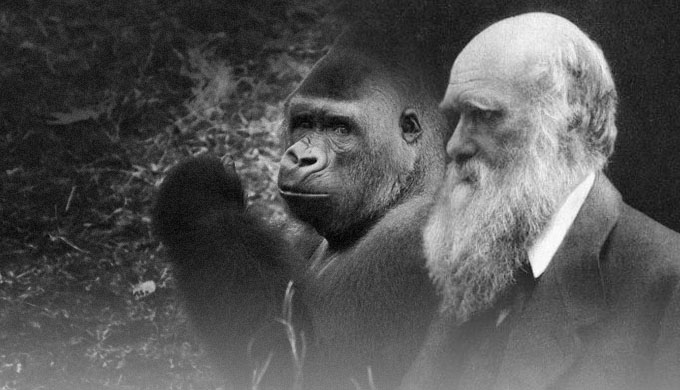
Evolution is it fact or fiction???
As a Christian, I do not believe that mankind evolved from apes.
However, I do believe that there is such a thing as evolution. So, let me be crystal clear on that last statement. Man did not evolve from apes; however, that does not mean that whippets did not evolve from greyhounds.
Science can prove microevolution (different breeds of dog or length of birds beaks), but it cannot prove macoevolution —Apes evolving into man or any other evolution of one kind of animal to another kind.
Here I am going to address a few scientific points that prove Charles Darwin’s theory of evolution is fiction and NOT fact.
• The Complexity of DNA
• The Complexity of the Cell
• Intelligent Design in Life
• The Fossil Record
The Complexity of DNA
How many decades have we heard that humans and chimpanzees share 98.8 of DNA, so we must have come from a common ancestor. Well, it turns out that scientific “fact” is not accurate. That number was from when only viewing ten percent of the whole chimpanzee genome. Now that the whole chimpanzee genome has fully been sequenced, it turns out that humans and chimpanzee share only around 85% of DNA. Way too much of an difference to be accounted for by random chance (i.e., evolution) in 6 million years.
This actually points to an intelligent designer. Anyone who is in the Information Technology field and understands how writing software code (which DNA is) works, knows that you do not start from scratch when you write software code. You start with code that you or someone else has written and used (for you techies out there, this is what GitHub or any code repo is for), then you modify it to fit the requirements of your current design. Hence, two programs that were created for two different purposes at two different times will have a high degree of the same amount of software code. Yet, since they were intelligently designed, they will perform totally different functions.
Evolutionists will state how they have proved evolution in a lab with bacteria. This experiment to prove evolution has gone on for decades and created hundreds of thousands of generations of bacteria. Yes, the bacteria have changed; microevolution. But guess what, it is still the same kind of bacteria. It has NOT evolved into something other than bacteria. No macroevolution. Nothing but bacteria adapting to its environment.
You see, unlike in Charles Darwin’s time, we now know that DNA is the key to life and controls the diversity that we see in life today. However, there is a massive problem with evolution and DNA. DNA is too complex to have been created by evolution. DNA IS A PROGRAMING LANGUAGE. Random changes (what evolution is) are the archenemy of programming languages. Random changes breakdown DNA, not improve it. It is a proven fact that the human genome is breaking down. Most of the examples that people use for evolution is actually something broken in the genome of that example. A loss of functionality for the animal, not a new function. There is diversity that was already in place in the human and animal genomes that can be acted upon. There are different cat and dog breeds, cattle can be bred to change their features. But cats and dogs cannot evolve gills and cattle cannot evolve wings. New functions must be added to the genome for that to happen, and random changes do not produce new function, they take away functionality.
For decades now we have been told that the fact that human and chimpanzee DNA is only 1% different is hard proof that humans evolved from chimpanzees. That 1% difference can easily be explained by evolution and is even expected. Maybe even up to a 5% difference in DNA between humans and chimpanzees could prove evolution. However, a 10% difference between human and chimpanzee DNA would disprove that humans evolved from chimpanzees. Well, it turns out that the scientific fact of a 1% difference between human and chimpanzee DNA was totally wrong. Now that we have completely mapped out human and chimpanzee DNA, it turns out that they are ~15% different. There is NO WAY that a 15% difference could tie humans to the chimpanzee evolution tree. Not enough time has passed for random mutations to have caused a 15% difference. Therefore, humans could NOT have possibly EVOLVED from chimpanzees.
Review my article DNA Proof of God to understand more about the complexity of DNA
The Complexity of the cell
In Darwin’s time it was thought that cells were blobs of protoplasm. However, it turned out that cells are extremely complex. We are learning more about the complexity of cells every day. They are or more complex than a factory. Cells are made up of various molecular machines and systems. Machines and systems are made by design not random chance.
ma·chine [məˈʃiːn] - An apparatus using mechanical power and having several parts, each with a definite function and together performing a particular task.
sys·tem [ˈsɪstɪm] - A set of things working together as parts of a mechanism or an interconnecting network; a complex whole.
Human cells have built-in machines and systems to detect and correct errors that occur during DNA replication. DNA polymerase, an enzyme responsible for copying DNA, checks each base as it adds them to the new DNA strand. If it inserts the wrong nucleotide, polymerase can pause, backtrack, and remove the mistake before continuing, which greatly reduces the chance of errors.
After replication is complete, specialized proteins scan the DNA for mismatched bases or small mistakes like insertions or deletions. These proteins cut out the faulty section and replace it with the correct sequence. This process is similar to how computers use error detection and correction codes: both rely on redundancy—extra information added to help spot mistakes—and consistency checks to ensure accuracy. Just as computers use these codes to maintain reliable data, our cells use these mechanisms to keep genetic information stable and healthy.
Proteins in the cell must be folded into precise 3D shapes. Cells use Chaperone Proteins to achieve this function. Chaperone Proteins act like molecular bodyguards by preventing misfolding, refolding damaged proteins and escorting proteins to degradation if beyond repair. Misfolded or damaged proteins are tagged and shredded. This is a biological analog to error correction via redundancy and cleanup, similar to digital systems described in error‑correction theory.
Anyone in the IT field fully understands the complexity of these machines and systems. Error detection and correction systems are designed systems that are extremely complex to function correctly. The system MUST know what the correct output should be before it can detect it. An error detection system cannot have a random baseline. Otherwise, it will detect errors when there is no error. Also, an error correction system must know what the correct outcome should be to correct it. These types of machines and system must be extremely precise and any mistake or randomness in them will inadvertently produce the wrong outcome.
Watch this mind‑boggling video on the cell. Your Body’s Molecular Machines
Just like mahcines and error dection/correction systems, the human cell is not something created by random chance, it was designed.
Intelligent Design in Life
As stated above, both the complexity of DNA and the complexity of cells scream that they were created with an intelligent design for the purpose of creating life. Programing code (DNA) and machines (cells) are not created by random chance; they are created by design with a purpose. Life itself was Intelligently Design.
Here is a very good discussion on the merits fo Intelligent Design - By Design: Behe, Lennox, and Meyer on the Evidence for a Creator
Fossil Record
The fossil record does NOT support the theory of evolution.
With the theory of evolution should display continuous, gradual changes to life. However, the fossil record shows the opposite. It shows an explosion of life. Must notably the Cambrian Period (about 538–485 million years ago) shows a dramatic surge in fossil diversity known as the Cambrian Explosion, when most major animal groups first appear in the fossil record. It highlights both the sudden abundance of hard-shelled organisms and the limitations of earlier fossil evidence.
There is a videon on the explanation and discussion on the Cambrian Explosion Can EVOLUTION Explain THIS!?
Also, according to the theory of evolution there should be countless transitional fossils. But that is not the case. For the few transitional fossils that have been found, it is debatable if they are really transitional lifeform.
Even Charles Darwin argued that the fossil record is real evidence for evolution, but he also openly acknowledged that it was incomplete, fragmentary, and far from showing every transitional form. He also acknowledged the issue with the sudden appearance of species in the fossil record.
“We should not expect to find in our geological formations an infinite number of those fine transitional forms which must have existed.” — On the Origin of Species
“The abrupt manner in which whole groups of species suddenly appear in certain formations, has been urged by several paleontologists as a fatal objection to the belief in the transmutation of species. But just in proportion as the geological record is imperfect, we shall only occasionally discover a fossiliferous formation rich in species.” — On the Origin of Species
The few “transitional” fossils that have been found can rightly be argued are not actually transition animals. For example Archaeopteryx, the claimed transition between dinosaurs and birds can be reasoned that it is just an early bird.
More to come.
The theroy of evolution is a huge subject and I am just scratching the surface with this article.